


I almost don't dare to admit it.
Especially since I am surrounded by bedding enthusiasts, duvet devotees, and pillow experts. But if I’m being completely honest, I have to confess that I slept on the same pillow for years and years one I originally received from my grandmother (from her guest room). As you can imagine, I wasn't exactly the most popular person at the office among my colleagues. My excuses: “But I just can’t part with it” and “What would I even replace it with?” didn't exactly win them over. Within no time, tips and recommendations were flying across the office.
The search for the right pillow, as I now know from experience, isn't something that is settled quickly for everyone. Many questions we receive are about sleeping position, support, and specifically about neck and shoulder complaints. There are countless pillows available, and one will be much more suitable for you than another. But what actually makes the difference, and how do you know when you’ve finally found 'the one'?
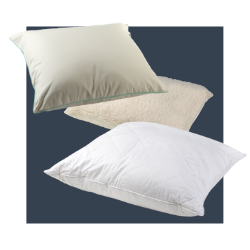

What kind of pillow do I need?
There is no such thing as the single "best" pillow for everyone. One pillow cannot possibly suit all 17.28 million inhabitants of the Netherlands (at the time of writing, September 2021). Every body is built differently and requires its own specific support. In our consultations, we always start by determining if someone is a back, side, or stomach sleeper. Based on that alone, you can already make a strong selection.
Next comes the type of material, and here too, there is a lot of variation. Wool, down, Tencel, bamboo, silk, kapok, cotton, latex, foam, and synthetic: these are the most common materials for both the filling and the ticking (the ticking is the fabric casing or cover around the filling).

What types of pillows are there?
There are countless types and sizes of pillows. Besides the material, the dimensions are worth considering. Normally, standard pillows in the Netherlands are 60 x 70 cm. You’ll see this size reflected in pillowcases (included with duvet covers). However, the well-known neck support pillow, the Silvana Support, is also available in 50 x 70 cm. This option is often recommended for taller people, as a slightly shorter pillow provides more sleeping space for the rest of the body. Latex pillows often come in different dimensions for the same reason.
There is also a difference in shape. Most people are familiar with the standard tapered pillow, where the edges taper off and the thickest part is in the center. This traditional shape is very suitable for stomach sleepers, though it can work for anyone. Then there are the so-called box pillows (gusseted). These have a consistent thickness all the way to the edge, providing more support for the neck and shoulders. A box pillow is ideal for side sleepers and retains its shape longer.
What is a good pillow for side sleepers?
Side sleepers, as the name suggests, spend most of the night on their side. This creates a large gap between the head and the mattress, and to properly support your neck and shoulders, that gap must be filled. Suitable pillows for this include box pillows, neck support pillows, and pillows with fillings of latex, wool, or memory foam.
The neck support pillow from Silvana deserves a special mention. The Silvana Support pillow is exceptionally well-suited for side sleepers. This pillow has been around for years, is recommended by many physiotherapists, and has earned its stripes when it comes to neck and shoulder support. It is available in six different variants, from wonderfully soft to perfectly firm, ensuring there is a match for every preference and need.

What is the best pillow for neck and shoulder complaints?
If you truly suffer from neck and shoulder pain, an ergonomic, form-stable pillow is often the solution. Pillows made of latex are form-stable, meaning they stay perfectly in shape and maintain their support throughout the night. The Fysioform Talalay latex pillow was recommended to me from several sides, so I am passing that recommendation on here. This Talalay latex pillow provides incredible support and is made of a durable material that lasts for years (not as long as my grandma's, but certainly about 5 years on average). And when it comes to comfort: the pillow stays nice and cool in the summer and cozy in the winter.
Pillow Maintenance
Finally, maintenance. A molton might seem like an old-fashioned concept to some, but a cotton molton pillow protector is both practical and hygienic. Your pillow will last much longer, and it absorbs perspiration, keeping the pillow much cleaner. As for washing, we could write an entirely separate blog on that some pillows are washable, others aren't, and the same applies to the dryer. So, always stick to the care label and you'll be fine.
Which pillow I finally chose? That’s a trade secret ;) But I can tell you that I definitely should have done this 10 years earlier. You really do have to listen to your colleagues sometimes.