Free shipping from € 50
Pay afterwards
Fast delivery
14 days approval period
THE SCIENCE OF RESTORATION

Deep Sleep is Not an
Accident
It’s a Result

We’ve spent 57 years studying the friction between the human body and the modern bedroom. These insights are the blueprint for your most restorative night’s rest, grounded in Dutch physiology and European innovation.

Postural Biomechanics5 Min Read

The Physics of Spinal Alignment During Deep Sleep Phases

An ergonomic deep-dive into how structural support influences vertebrate recovery and REM efficiency.

Thermal Physiology7 Min Read

The Physiology of Sleep Thermoregulation: Eradicating Night Sweats

An evidence-based analysis of the sleep microclimate, the human heat balance equation, and nocturnal moisture management.

Somnology Research6 Min Read

The Impact of Cranial Elevation on Morning Tension

Analysis of gravitational pressure on cranial nerves based on pillow loft and material density.

NEUROLOGICAL RECOVERY6 Min Read

The Neurobiology of Slow-Wave Sleep and Glymphatic Filtration

How deep sleep architecture facilitates the brain's waste-clearance system and metabolic restoration.

CHRONOBIOLOGY RESEARCH5 Min Read

Circadian Rhythm Disruption: The Impact of Artificial Light

A technical analysis of how blue-light frequency exposure alters the biological clock and sleep onset.

MATERIAL SCIENCE8 Min Read

Hygroscopic Efficiency: Protein-Based vs. Synthetic Fibers

Measuring the dynamic moisture-wicking properties of organic wool for micro-climate stabilization.

INTERFACE PRESSURE SCIENCE7 Min Read

Capillary Flow and Tissue Perfusion under Varied Densities

Analyzing how localized pressure redistribution prevents micro-arousals and maintains circulation.

PSYCHOACOUSTIC RESEARCH4 Min Read

Acoustic Thresholds and Sleep Stage Fragmentation

Researching the decibel limits of environmental noise and the efficacy of acoustic isolation.

KINESIOLOGICAL SLEEP STUDY6 Min Read

Skeletal Muscle Atonia: Passive Support in REM Phases

Exploring the transition from active muscle tone to total skeletal reliance on mattress surfaces.

Weids Research Insight

The Physics of
Spinal Alignment

Key Scientific Insight

Spinal alignment is a dynamic biomechanical state. The transition through deep NREM sleep and into REM sleep involves skeletal muscle atonia, shifting the entire burden of skeletal support from your active musculature directly to the passive mechanics of the mattress and pillow.

01. Support Dynamics Across Sleep Phases

External Support Load Matrix

Wake
N1-N2
N3
REM

As sleep deepens, the body's internal "postural tone" goes offline. This data maps the increasing reliance on external bedding support during states of profound atonia.

Wakefulness10% RELIANCE

Postural tone is fully active. Alignment is maintained by muscle contraction.

LOW RISK
Light Sleep (N1-N2)30% RELIANCE

Muscle activity begins to decrease. The body is still capable of protective shifts to avoid pain.

Deep Sleep (N3)65% RELIANCE

Ligamentous Creep phase begins. Gravitational loading on intervertebral discs increases significantly.

REM Sleep (Atonia)100% RELIANCE

100% burden shift. Bedding must absorb mass to prevent joint torque and nerve stretch.

02. Positional Biomechanics

Gravity exerts unique vectors of force depending on your orientation. Select a sleeping posture below to analyze the required geometric counter-pressure.

Maintain Lordosis

Supine Mechanics

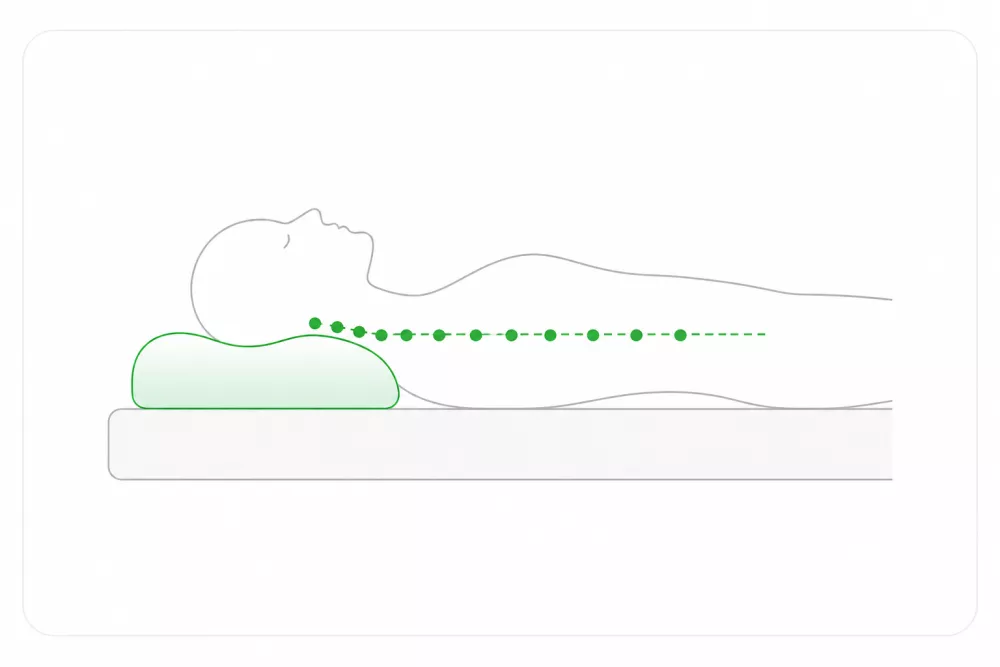
Sleeping on the back distributes mass evenly, but creates a specific void under the cervical spine (neck) and lumbar spine (lower back). If the mattress is too firm, the lumbar gap remains unsupported, leading to muscular guarding. If the pillow is too high, it forces the neck into unnatural flexion, constricting the airway.

Supine Alignment Vector

03. Regional Ligamentous Creep

When muscles relax in deep sleep, soft tissues undergo "Creep"—slow deformation under constant load. Drag the slider to observe how biomechanical stress accumulates over an 8-hour sleep cycle.

Sleep Onset 1 Hour In Bed Waking

Elastic Phase: Tissues recover rapidly. Minimal structural risk.

Cervical Spine

Sub-optimal loft causes facet joint imbrication. Nerve compression in the neck is frequently mistaken for simple muscle tension.

Thoracic/Shoulder

Overly firm mattresses prevent lateral shoulder immersion, "jacking" the upper spine upward and causing severe acromioclavicular compression and lateral spinal deviation.

Lumbar Creep

During N3 sleep, unsupported pelvic sinking stretches the lumbar ligaments. This "creep" fatigue is often worst in the early morning hours.

04. Applied Material Physics

01. The Cervical Bridge

The biomechanical suspension of C1-C7 vertebrae over the physical gap created by shoulder width. Our specialized neck-support pillows are engineered to provide the exact push-back force required to maintain this bridge during REM atonia.

02. Viscoelastic Hysteresis

Viscoelastic materials are temperature-sensitive, allowing them to soften around the body's contours. More importantly, they exhibit high hysteresis—the physical ability to absorb kinetic energy without pushing back violently against the joints.

03. Pelvic Stabilization

For lateral sleepers, gravity exerts torque on the upper hip, twisting the lower spine. A structural body pillow acts as a biomechanical wedge, maintaining parallel hip alignment and neutralizing rotational shear forces.

Weids Research Insight

The Physiology of Sleep Thermoregulation:
Eradicating Night Sweats

An evidence-based analysis of the sleep microclimate, the human heat balance equation, and the material science of nocturnal moisture management.

Key Scientific Insight

Night sweats are rarely a spontaneous physiological error; they are primarily a failure of the Sleep Microclimate. When the bedding envelope cannot adequately buffer humidity, the body's natural evaporative cooling mechanism is suppressed, triggering a cascade of thermal stress and sleep fragmentation.

The Biomechanics of Thermal Sleep Architecture

To enter deep, slow-wave sleep (NREM Stage 3), your core body temperature must drop by approximately 1°C. The body achieves this by dilating peripheral blood vessels (in the hands and feet) to dissipate heat into the surrounding environment. If the bedding traps this heat, the core temperature remains elevated, inhibiting the onset of deep sleep and severely restricting the brain's glymphatic clearance (metabolic waste removal).

Core Temperature vs. Sleep Architecture

Deep sleep occurs only when core body temperature successfully dips below the physiological threshold.

Fig 1. Thermal Deviation and Sleep Stage Disruption.

The Thermodynamics of Perspiration

During a standard 8-hour sleep cycle, the human body passively exhales and transpires roughly 300ml to 500ml of vapor. To understand why synthetic bedding fails, we must look at the human heat balance equation:

$$S = M - W \pm R \pm C \pm K - E$$

Where heat storage ($S$) is determined by metabolic rate ($M$), minus work ($W$), plus/minus radiation ($R$), convection ($C$), and conduction ($K$), minus evaporative heat loss ($E$).

When you sleep under synthetic polyester—which possesses virtually zero moisture vapor transmission rate (MVTR)—the $E$ variable is neutralized. The relative humidity within the bed spikes above 60%. Because sweat cannot evaporate in a saturated environment, the body panics and produces more sweat, resulting in the clinical presentation of night sweats.

Textile Fibre Thermal Mechanism Moisture Capacity Research Application
Keratin (Wool) Hygroscopic Buffering
Absorbs vapor internally while feeling dry externally.
Absorbs up to 30% of its dry weight. Chronic night sweats; year-round thermal stability.
Cellulose (Cotton) Porous Breathability
Allows convective airflow ($C$).
Moderate (holds ~8%). Baseline structural layer (fitted sheets/moltons).
Polymer (Polyester) Thermal Trapping
Reflects latent heat back to the epidermis.
Near zero (0.4%). Counter-indicated for sleep hygiene.

Prescribe Your Microclimate

Discard synthetics and engineer a scientifically sound sleep environment. Explore our laboratory-selected collection of hygroscopic wool and Tencel bedding.

Analyze Duvet Systems →
✓ EVIDENCE LEVEL: HIGH (TIER 1 & 2)

Annotated Source References

  • Okamoto-Mizuno, K., & Mizuno, K. (2012). Effects of thermal environment on sleep and circadian rhythm. Journal of Physiological Anthropology. (Validates the 18°C ambient / 30°C microclimate differential).
  • Harding, E. C., Franks, N. P., & Wisden, W. (2019). The Temperature Dependence of Sleep. Frontiers in Neuroscience. (Details peripheral vasodilation and core temperature drop requirements).
Weids Research Insight

Biomechanical Impact of
Cranial Elevation

Key Scientific Insight

Optimal pillow height is not a static number—it is highly dependent on mattress firmness (sinkage) and biacromial breadth (shoulder width). A softer mattress allows greater shoulder compression into the comfort layers, actively reducing the cranial elevation required to maintain a neutral cervical axis. Deviation from this dynamic "Neutral Zone" results in a non-linear increase in intervertebral disc stress (MPa) and muscle fatigue.

The Impact of Cranial Elevation on Morning Tension

01. Biomechanical Response Simulator

Variable 1: Mattress Sinkage

Mattress firmness shifts the baseline for optimal cranial elevation.

Variable 2: Pillow Height 11 cm
Flexion Low Neutral Zone Flexion High
Cervical Alignment

Horizontal neutral alignment achieved.

Von Mises Stress
0.30 MPa

Minimal shear force on C3-C7 discs.

sEMG Muscle State
Resting

Protective guarding deactivated.

Spinal Load Distribution (FEA)

Current Status: Optimal load distribution. Stress is minimized across the annulus fibrosus, reducing herniation risk.

Cervical Muscle Fatigue (sEMG)

Current Status: Musculature is at rest. SCM and Trapezius guarding mechanisms are inactive.

02. Deep-Dive Scientific Methodology

FEA of Stress Distribution

Referring to the methodology employed by Bi et al. (2020), finite element modeling allows us to visualize internal stresses that cannot be measured in vivo.

  • Findings: Side-lying positions creating extreme lateral bending move stress from the nucleus pulposus to the annulus fibrosus, increasing mechanical strain.
  • The Vector: Von Mises stress on vertebrae C3-C7 is mathematically minimized when the height exactly bridges the biacromial breadth minus mattress sinkage.

03. Practical Translation Matrix

Parameter 01

Adjustability

Modular

Permits micro-adjustments to sync with specific mattress firmness and biacromial breath.

Parameter 02

Material Yield

Latex / Visco

Prevents "Height Decay" during the 8-hour sleep cycle, maintaining the chosen neutral axis.

Parameter 03

Geometry

Contoured

Supports the lordotic curve while allowing the occiput to sink, reducing interface pressure.

Parameter 04

Microclimate

31-35°C

Thermal range optimization via natural/PCM materials prevents physiological micro-arousals.

Biomechanical Application

04. Technical Support Infrastructure

Achieving spinal neutrality requires a synchronized support system. Our specialized, adjustable neck-support pillows and orthopedic mattress foundations are engineered to adapt to your specific "Neutral Zone."

✓ EVIDENCE LEVEL: HIGH (VERIFIED RESEARCH)

Annotated Source References

  • [1] Bi, et al. (2020) Effect of pillow height on head-neck complex: a finite element analysis.
  • [2] Fazli, et al. (2018) The effects of pillow height and angles on sleep biomechanics.
  • [3] Jeon, et al. (2014) The effect of pillow height on neck muscle activity.

Safety Boundary: Weids Research Insights provides educational data for comfort optimization. Not medical advice.

Weids Research Insight

The Neurobiology of
Slow-Wave Sleep

Key Scientific Insight

The glymphatic system is the brain's macroscopic waste clearance network. It is highly active during N3 Slow-Wave Sleep and is responsible for flushing out neurotoxins like beta-amyloid.

01. Glymphatic Efflux Dynamics

Filtration Efficiency by Sleep Stage

The Wakeful Suppression

Glymphatic clearance is nearly suspended during wakefulness and sharply suppressed by stress or micro-arousals.

03. Optimizing the Sleep Environment

01. Cervical & Venous Alignment

Weids Research Insight

Hygroscopic Efficiency:
Protein vs. Synthetic Fibers

Key Scientific Insight

Organic wool (keratin) possesses a unique bicomponent structure with a hydrophobic epicuticle and a highly hydrophilic cortex. This allows it to absorb up to 35% of its weight in moisture vapor without feeling wet to the touch, actively regulating the sleep microclimate through the Latent Heat of Sorption.

01. Moisture Vapor Transmission Rate (MVTR)

During deep sleep, the human body transpires up to 500ml of vapor. The capacity of a duvet to move this vapor from the epidermis to the ambient bedroom air is calculated using the Moisture Vapor Transmission Rate (MVTR):

$$MVTR = \frac{\Delta m}{A \cdot t}$$

Where \(\Delta m\) is the change in moisture mass, \(A\) is the surface area of the textile, and \(t\) is time. Synthetic fibers (like polyester) have an MVTR nearing zero. When vapor cannot transmit, it condenses back into liquid sweat on the skin, drastically raising Relative Humidity (RH) inside the sleep pocket and forcing a micro-arousal.

Relative Humidity (RH) Over 8 Hours

This telemetry compares the microclimate humidity of a standard polyester duvet versus a 100% Texel wool duvet. Note how synthetics rapidly surpass the 60% RH threshold, triggering physiological thermal stress.

02. The Bicomponent Keratin Filament

1. The Hydrophobic Epicuticle

The outermost layer of a wool fiber consists of microscopic overlapping scales coated in a natural lipid (lanolin). This layer repels liquid water, meaning the fiber feels physically dry against the skin even when it is actively working.

2. The Hydrophilic Cortex

Beneath the outer scales lies the cortex, which is highly porous. It pulls moisture vapor directly through the microscopic gaps in the scales, storing the water molecules internally. As the water binds, it releases a tiny amount of thermal energy, preventing sudden temperature drops.

03. Upgrading Your Microclimate

The Four-Season Wool Configuration

To truly eradicate microclimate instability, the synthetic core must be replaced. A modular, layered wool duvet allows you to adjust the physical mass of the bedding while relying on the keratin fibers to manage the MVTR automatically.